Following on from unforgettable novels and historical documentaries, this post turns to six history books that linger long in the memory. (* Indicates it has been read more than once.)
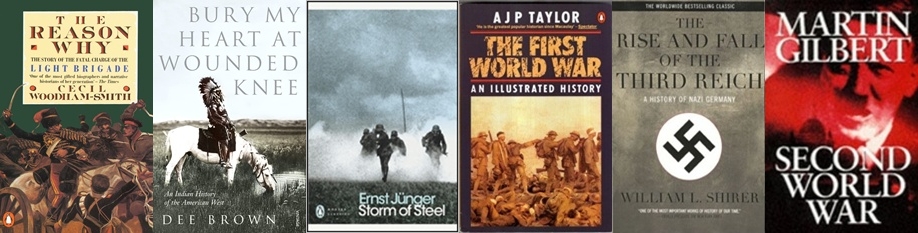
The Reason Why, Cecil Woodham-Smith, 1953*
The Charge of the Light Brigade is one of the most famous military disasters. Taking place during the Crimean War (1853-56), this book expertly examines the Victorian age, the personality clashes, the glory, and the mistakes that led to the British light cavalry’s frontal assault against a Russian artillery battery. Woodham-Smith keeps things moving well and her style of writing is entertaining. The book’s title is from Tennyson’s 1854 poem ‘The Charge of the Light Brigade’: “Theirs not to reason why, Theirs but to do and die. Into the valley of Death, Rode the six hundred.”
Bury My Heart at Wounded Knee, Dee Brown, 1970
For Native Americans, the advance of white settlers in the American West in the late 19th century would have felt relentless and threatening. Brown astutely explains how the indigenous peoples lost their way of life, religion and culture. The author makes the reader look at things from their perspective: “Americans who have always looked westward when reading about this period should read this book facing eastward.”
Storm of Steel, Ernst Jünger, 1920
They are often enemies, but the British and German militaries possess similar qualities. Courage, organisation, pragmatism and a dark sense of humour. Jünger was a German officer during the First World War, and this brutally honest memoir is powerful and haunting for its description of life and combat on the Western Front. Many scenes are memorable, but two stick out. One is his admiration for the British, such as a solider calmly smoking a pipe despite his legs being blown off. The other is Jünger (understandably) breaking down in tears after a battle.
The First World War: An Illustrated History, A. J. P. Taylor, 1963*
Taylor shows immense skill in covering all the major events of 1914-18 with pace and panache. His style is engaging, but still offers sharp analysis. If a person was looking for one book to explain the First World War this would be the most helpful. By the way, Taylor was also famous for his lectures and public speaking skills. His TV series on ‘How Wars Begin’ saw him talk for around 30 minutes on each subject… all without notes and an autocue.
The Rise and Fall of the Third Reich, William L. Shirer, 1960
It’s not necessary for the role, but if a historian was going to cover a subject, they’d gain some credibility by being around during the actual events. Shirer was a foreign correspondent in Germany from 1934 to 1940. He saw how Adolf Hitler took the National Socialist German Workers’ Party (aka Nazi Party) into power and then onto the Second World War. It’s a massive, fascinating work of non-fiction, and it was reviewed in this post from 2014.
Second World War, Martin Gilbert, 1989
Considering the colossal scale of the 1939-45 conflict, it’s fitting that this work is similarly enormous. Gilbert’s book covers everything in a detailed, intelligent manner. From the invasion of Poland to the crushing defeats of totalitarian regimes, the global scope of the Second World War is adroitly handled by the author. Despite reading this book only once in the 1990s, its potency has not diminished.